Noor-e-Samandar
By Kiran Imam
International Whale Shark Day 2026
Featured Image by Sebastian Pena Lambarri via Unsplash
It was a mild blue day. My slumber had just ended, and the sky had never looked so beautiful, gazing at the stars above. They were fading slowly, one by one, dissolving into the early hush of dawn as if the morning were drinking them from the sky.
The sea lay beneath me, vast and patient.
I had spent the night on the deck of my father’s old fishing boat, wrapped in a woollen shawl that smelled faintly of salt, diesel, and sun-dried rope. The boat was called Noor-e-Samandar (Light of the Sea) and its blue paint had peeled away in places, revealing wood weathered by years of tides. My father said every scratch on her hull was a memory. I used to think that was only something adults said when they wanted to make old things seem important.
But that morning, with the horizon beginning to glow gold and lavender, I believed him.
The water around us was still. Not empty, never empty, but still in the way a sleeping creature might be still. Small silver fish flashed near the surface, vanishing before the eye could understand that they had been there. A gull circled once above our mast, crying into the dawn, then disappeared toward the distant coast.
My father stood at the stern, coiling a rope with slow hands.
“You should sleep inside,” he said without looking at me.
“I was sleeping.”
“You were shivering.”
“I was thinking.”
He laughed softly. “That is worse.”
I smiled and pulled the shawl closer around my shoulders. At seventeen, I had become old enough to believe that thinking was a kind of adventure. I filled notebooks with questions I did not know how to answer: Why did the sea change color? Did fish remember where they were born? Could a creature be lonely if it lived among thousands of others? Were there places beneath us where sunlight had never arrived?
My father had never gone to university. He had learned the sea from his father, and his father before him. Yet he knew things no classroom could explain. He could sense a storm from the weight of the air. He could tell whether fish had passed through a place by the movement of birds. He knew which currents brought jellyfish near the shore and which ones carried plastic from cities far away.
That morning, he had brought me farther offshore than usual.
“We wait here,” he said.
“For what?”
He tied the rope to a metal ring on the deck, then looked toward the brightening water.
“For a visitor.”
I turned to follow his gaze. At first, I saw nothing but sea.
The sun appeared slowly, its edge rising from the horizon like a golden coin being lifted from beneath the water. Light spilled over the waves. The world changed all at once. The sea that had been dark blue became turquoise, then silver, then something too alive to name.
My father raised one hand.
“Look.”
A shape moved beneath the boat.
At first, I thought it was a shadow from a cloud, though there were no clouds above us. Then the shape deepened, became darker, wider, and impossibly large. It passed beneath our hull with such calmness that the boat barely rocked. My breath caught in my throat.
A giant back rose near the surface.
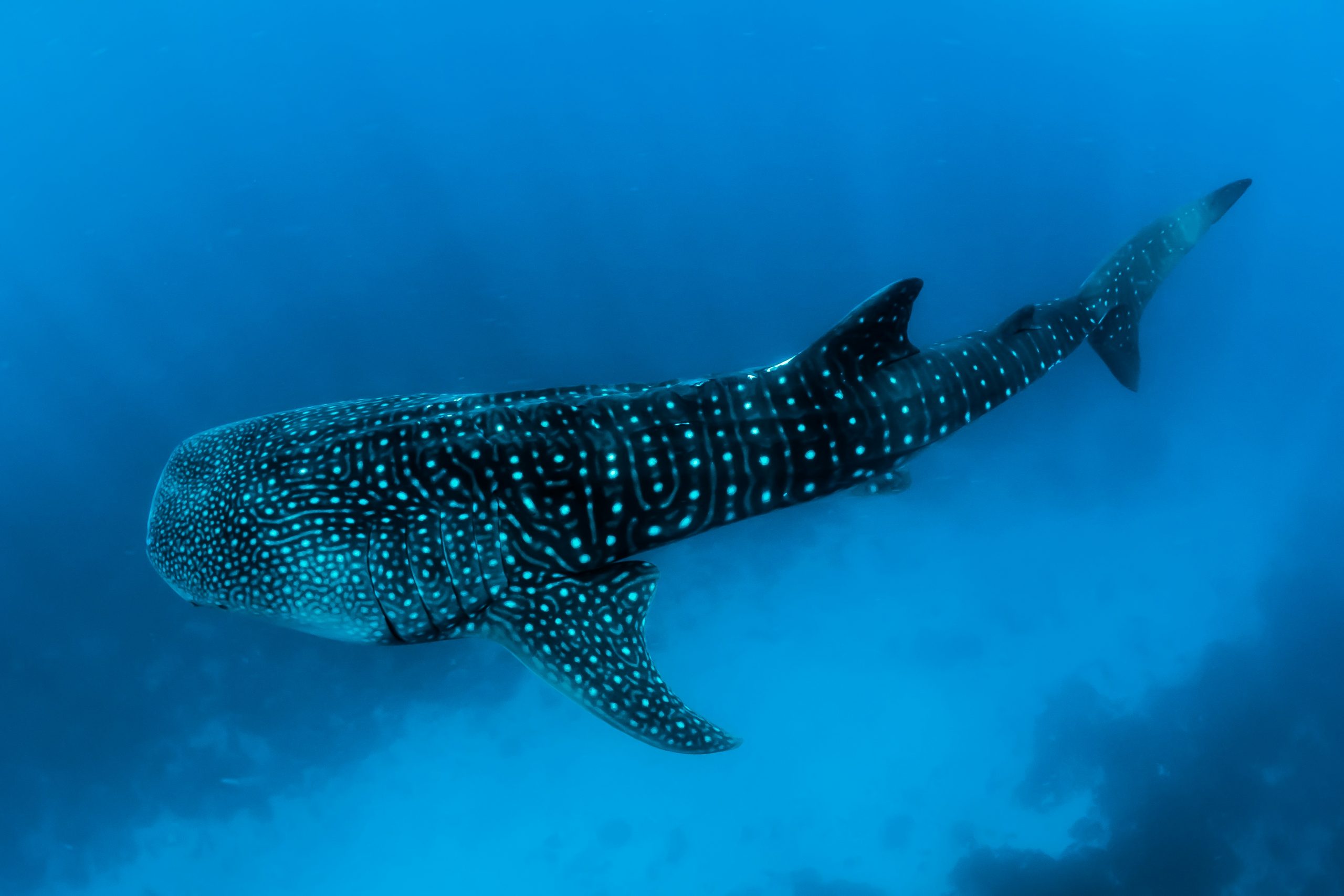
It was gray-blue, patterned with pale spots and soft stripes, as though someone had scattered starlight across its skin. Water slid over it in shining streams. Then came a broad head, flattened and gentle, with a mouth so wide that it seemed capable of swallowing the sunrise.
But it did not look frightening.
It looked ancient.
“It is a whale,” I whispered.
My father shook his head. “Whale shark.”
The creature drifted beside our boat. Its body was longer than the boat itself, perhaps twice as long, though I could not truly understand its size. A whale shark was the largest fish in the sea, my father told me once, but seeing it was different from hearing it. There are facts that sit quietly in books, and there are facts that enter the body like thunder.
The whale shark moved without hurry. Its enormous tail swept side to side, carrying it through the water as gracefully as a ribbon floating in wind. Tiny fish travelled alongside it, sheltering near its body. Some darted in front of its mouth. Others swam close to its fins as though they belonged to it.
“Is it dangerous?” I asked.
“No,” my father said. “It eats the smallest things.”
I watched as it opened its mouth. The opening was huge, black, and deep, but there was no violence in it. The whale shark glided forward, taking in seawater filled with plankton—tiny drifting life too small for most people to notice. It would filter the water through its gills, keeping the nourishing fragments and releasing the rest back into the sea.
The largest fish in the world, feeding on creatures smaller than a grain of rice.
There was something almost holy about that.
My father lowered the engine until it fell quiet.
“No sudden movements,” he said. “Let it decide how close it wishes to come.”
The whale shark circled us once.
I leaned over the side, gripping the rail until my knuckles turned pale. Beneath the surface, one dark eye turned upward. For only a moment, I imagined that it had seen me not merely as a shape above the water, not merely as noise or shadow, but as another living being trying to understand it.
Then it moved away.
Its spotted body descended into the blue, becoming softer and dimmer until it disappeared entirely.
I remained by the railing long after it was gone.
“Will we see it again?” I asked.
“Maybe.”
“That is not an answer.”
“It is the sea’s answer,” my father said.
For weeks afterward, the whale shark filled my thoughts.
At school, I drew its dotted back in the margins of my notebooks. During lessons, while teachers explained equations and dates and chemical reactions, I imagined it crossing the open ocean below the moon. I imagined it travelling through warm currents, from one coastline to another, following food invisible to human eyes. I wondered whether it remembered our boat. I wondered whether the same stars that watched me from my roof also watched it from beneath the waves.
I began borrowing books from the small community library near the harbor. There were books about coral reefs, whales, dolphins, sea turtles, and mangroves. There was one faded encyclopedia with a section on sharks. I learned that whale sharks were not whales at all, though their size had given them the name. They were sharks—fish with gills, cartilage instead of bones, and tails powerful enough to carry them across oceans.
I learned that their white spots were unique, like fingerprints.
That fact changed everything for me.
Each whale shark carried its own map of stars.
Each one could be recognized.
Each one was not simply a whale shark, but an individual with a life I could barely imagine: a beginning somewhere in a warm sea, years of slow growth, long migrations, scars from boats or nets perhaps, encounters with divers, storms, other sharks, hidden feeding grounds, changing temperatures, and silent journeys through water deeper than any city building was tall.
I started visiting the harbor after school.
The harbor was loud in the afternoons. Men repaired nets. Women sorted fish into metal baskets. Children chased one another between boats, shouting and laughing until someone’s mother called them home. The air smelled of salt, smoke, and old wood. There were always gulls waiting for scraps.
One afternoon, I found my father sitting beside a pile of tangled netting.
“Baba,” I said, “do people catch whale sharks?”
He did not answer immediately.
“Yes,” he said at last.
“Here?”
“Not always on purpose.”
I sat beside him.
He picked a piece of plastic from the net. It was a bright red strip from a food wrapper, tangled among seaweed and scales.
“Sometimes they get trapped,” he continued. “Sometimes boats hurt them. Sometimes they come near the coast because there is food. Sometimes the sea brings them close to people who do not understand what they are seeing.”
I looked toward the water.
“Can’t we protect them?”
My father glanced at me. His face was tired, but his eyes were kind.
“We can try.”
That evening, I wrote the first page of what became my whale shark journal.
I did not know then that the journal would follow me through the years. I did not know that it would carry me farther than my father’s boat ever could. At the time, I only knew that I wanted to remember the creature with the starlit skin.
I wrote:
Today I learned that something can be enormous and still need protection.
The next year, a marine conservation group visited our school. They brought posters, photographs, and a projector that made a loud clicking sound before showing images on the classroom wall. The presenter was a woman named Dr. Sana, who wore a blue scarf and spoke with the quiet confidence of someone who had spent her life listening to the sea.
She showed us photographs of whale sharks swimming beside divers. In the images, the divers looked tiny like drifting leaves beside a moving mountain. She explained how scientists photographed the spots on whale sharks to identify individuals. She described how whale sharks could travel great distances, sometimes appearing in the waters of different countries across different seasons.
Then she showed a photograph of a whale shark with a deep cut along its side.
“A boat strike,” she said.
The classroom became silent.
Another image showed a whale shark tangled in fishing gear.
“Accidental capture,” she said.
Then came a photograph of a shoreline littered with plastic bottles, bags, wrappers, and broken sandals.
“Pollution does not stay where it is thrown away,” Dr. Sana told us. “A plastic bag dropped in a street can travel through drains, into rivers, and finally into the sea. In the ocean, it becomes someone else’s problem.”
I looked down at my hands.
After the presentation, most students rushed out for lunch. I stayed behind.
Dr. Sana was packing her posters into a cardboard tube when I approached her.
“Have you seen one?” I asked.
“A whale shark?”
I nodded.
“Yes,” she said, smiling. “Many times.”
“What does it feel like?”
She paused, as if she wanted to answer honestly.
“It feels like meeting a piece of the planet that existed before you and will, if we are careful, exist long after you.”
I thought of the whale shark beneath my father’s boat. Its eye. Its quietness. Its body covered in pale constellations.
“I saw one once,” I said.
Dr. Sana stopped packing.
“Where?”
I told her.
When I finished, she looked at me differently—not with surprise exactly, but with attention.
“Write it down,” she said.
“I already did.”
“Good. Keep writing. The sea needs people who notice.”
The years moved forward the way tides do: steadily, even when one is not watching.
I studied biology. I learned the names of things I had once only wondered about: plankton blooms, coral spawning, migration routes, food webs, coastal ecosystems. I learned that oceans were not endless, not invincible, not able to swallow everything humans gave them. I learned that warming waters could change where animals fed and travelled. I learned that shark populations around the world faced pressure from overfishing, habitat damage, vessel collisions, and pollution.
But I also learned about hope.
I learned about fishers who released whale sharks from nets. I learned about researchers who tagged sharks and studied their movements. I learned about communities that protected marine animals because living wildlife could bring more lasting value through responsible tourism, education, and healthy ecosystems than through harm. I learned that conservation was not only about sadness. It was about choices.
At twenty-two, I joined a small research expedition as a volunteer.
The boat was larger than my father’s but still modest: white sides, a shaded deck, scientific equipment packed into waterproof cases. We travelled before sunrise, moving over water that changed from black to violet to blue. I carried notebooks, cameras, identification sheets, and the nervous excitement of someone who had waited years for a chance like this.
Dr. Sana was there.
She had more gray in her hair now, but her smile was unchanged.
“You kept writing,” she said when she saw the journal in my bag.
“I did.”
“Good,” she replied. “Then you are ready.”
Ready for what, I did not know.
By midmorning, we reached an area where the water shimmered with life. Small fish flickered below the surface. Birds plunged from the sky. The sea seemed to breathe more quickly there, rising and falling around us.
One of the researchers pointed.
“Whale shark!”
Everyone turned.
A dorsal fin cut through the water.
Then another appeared farther away.
And another.
I had imagined seeing one again for so long that the reality felt unreal. Three whale sharks moved through the clear water, their spotted backs just beneath the surface. They fed slowly, mouths opening as they passed through clouds of plankton. Remoras clung to their bodies. Schools of fish surrounded them, flashing gold and silver.
The researchers worked carefully. They took photographs of the spot patterns behind the sharks’ gills, recording each individual. No one shouted. No one reached into the water. We watched from a respectful distance, allowing the animals to remain what they were: wild, unowned, and free.
Then Dr. Sana touched my arm.
“There,” she said.
A whale shark swam near the side of the boat.
Its pattern stopped me cold.
Across its back, near the fin, was a scatter of pale spots that curved like a broken crescent. A cluster of larger dots followed beneath them, like stars gathered around a moon.
I knew that pattern.
Or perhaps I only wanted to know it.
I opened my old journal with trembling hands. Near the first pages was a drawing I had made after the morning with my father. It was clumsy, drawn by a seventeen-year-old who had never expected the sketch to matter. But there it was: a curved line of bright spots near the fin. A cluster beneath it.
“It cannot be,” I whispered.
Dr. Sana looked from the drawing to the shark.
“Photographs and pattern software will tell us more,” she said gently. “But it is possible.”
The whale shark passed beneath the boat.
For a few seconds, I saw the whole of it in the clear water: the wide head, the powerful tail, the constellation of spots, the gentle movement through a world that had changed so much since I first saw it.
My eyes filled with tears.
Not because I was certain it was the same whale shark.
But because, whether it was or not, it carried the same message.
The sea remembers.
It remembers the hands that pull plastic from nets. It remembers engines slowed in respect. It remembers hooks, oil, noise, and carelessness too. It remembers every decision made along its coasts and above its depths. The ocean is not a distant place. It touches every shore, every cloud, every meal, every breath of air.
That evening, when the expedition boat returned toward land, the sun sank behind us in a blaze of orange and pink. I stood at the rail as the sky darkened. The first star appeared above the horizon, bright and small.
For years, I had thought whale sharks looked like they carried the sky on their backs.
Now I wondered if the sky carried them too.
I thought of my father’s old boat, Noor-e-Samandar. I thought of the mild blue morning when I first saw a giant rise from beneath the water. I thought of the whale shark feeding on plankton, peaceful and enormous, asking nothing from us except room to live.
When I reached home, I opened my journal to a fresh page.
The paper was worn at the edges. Salt had touched it. Rain had touched it. Time had changed the handwriting from the uncertain strokes of a girl into the steadier lines of a young woman.
I wrote:
The whale shark is still out there.
It is crossing a blue world under the same moon.
May we become worthy of sharing it.
Comments are closed